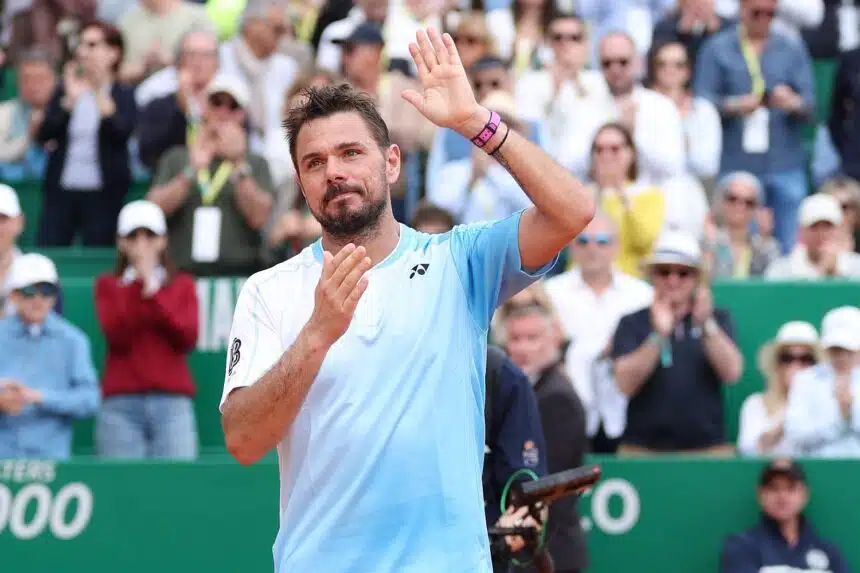
Trying to make your name in a sport dominated by a select few players was a challenge Stan Wawrinka seemed to relish.
The Big Four were Roger Federer, Rafael Nadal, Andy Murray, and Novak Djokovic. Between 2004 and 2023, they won 69 of the 79 Grand Slams held. During this period, only one player outside of the quartet won a major three times – Wawrinka.
Wawrinka’s triumphs were no fluke. On his way to the 2014 Australian Open title, he defeated both Djokovic and Nadal, as well as three other seeded players. The following year, he defeated Federer and Djokovic to win the French Open. Then, at the 2016 US Open, he beat Juan Martin del Potro, Kei Nishikori, and Djokovic in consecutive matches.
In his prime, Wawrinka established himself as a player who thrived on the biggest courts in the world. Besides his three Grand Slams, which is the same amount won as Murray, he reached the quarter-finals or better of a major on 15 other occasions.
“There is nothing negative about this life for me. I loved everything,” Wawrinka said after playing the last match of his career at the Swiss Indoors, losing 7-5, 7-6(2) to world no.21 Jiri Lehecka.
“Whether it was the difficulties or the sacrifices you have to make. I always told myself, whatever happens, this is simply fantastic. An enormous privilege.”
Wawrinka, nicknamed Stanimal for his physical aggression and stamina at his peak, made his ATP debut at the 2003 Gstaad Open at 18. That tournament was where he made his first breakthrough, but it was two years after his debut with a run to the final.
Wawrinka’s career has been as much about perseverance as anything else. After winning his first title at the Umag Open in 2006, he had to wait almost another four years before he claimed any more silverware. He would then win 14 of his 16 Tour-level titles between 2011 and 2017.
“I worked extremely hard right until the end to remain competitive,” Wawrinka reflected.
“I managed to extend my career by about ten years, more than I could ever have dreamed of. I pushed my limits well beyond the maximum and squeezed every last drop out of the lemon.”
There was no doubt that Wawrinka played at times in the shadows of Federer, who is regarded as one of the all-time greats. Together they won the 2008 Olympic doubles gold medal. He has a lopsided record against the Swiss Maestro, winning just three of 26 meetings on the Tour. In one of those clashes at the 2014 ATP Finals, Wawrinka admits it was one of his biggest regrets as a player.
“I had a match point and tried to serve and volley, but it didn’t work,” he said.
Wawrinka still established himself during this period as a fan favourite and earned a place among the world’s best. He was ranked as high as third in the world and spent 267 weeks in the world’s top 10.
Injury also played a part in his career. He underwent right knee surgery in 2007, two left knee surgeries in 2017, and two more surgeries on his left foot in 2021. He also dealt with an ankle injury between 2023 and 2024.
It is perhaps a miracle that Wawrinka has managed to keep playing professionally until age 41. Granted, this season he has produced few high-profile wins, with a 1-11 record against top-50 players. However, he has still recorded 12 Tour-level wins since turning 40, more than anyone else since the ATP Tour was established in 1990.
“As a competitor, you live for the big matches and the victories, and I haven’t had so many of those in recent years. That makes the transition (into retirement) easier.” He said.
Wawrinka had the luxury of being able to end his career on his own terms, playing in front of his home crowd for one last time. This year marked his 19th main-draw appearance in Basel, a record he shares with Federer.
“Saying goodbye here in Switzerland, with so much love from the fans, makes me a little sad, but deep down inside I’m happy. It was perfect.” He concluded.
Although Wawrinka’s next move remains uncertain, he retires as one of the few players to have broken the Big Four’s stranglehold on men’s tennis through his own achievements.