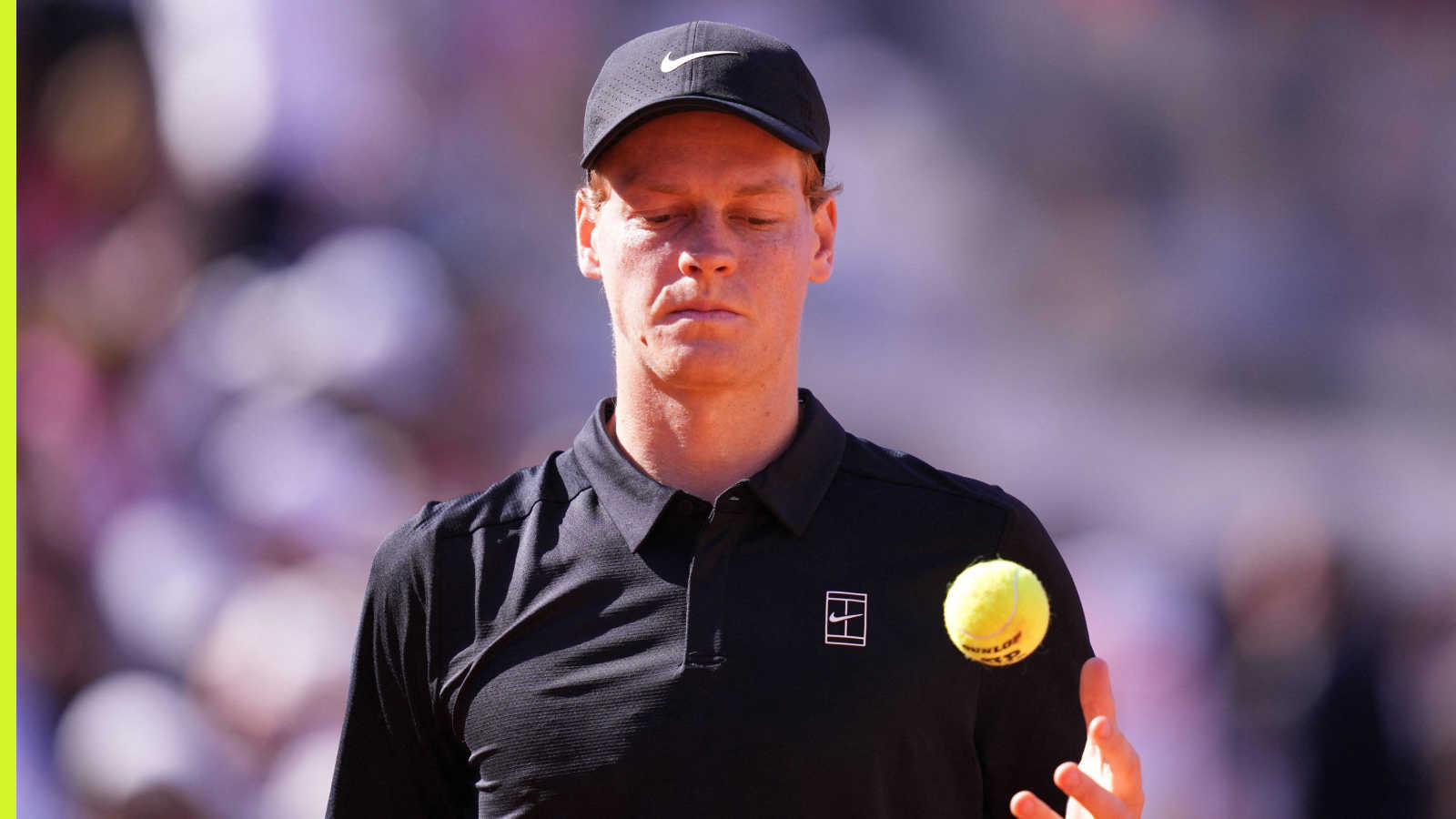
Jannik Sinner has been handed a worrying injury update just days after he was forced to withdraw from the China Open, with surgery now a possibility for his ongoing knee issue.
The Italian has been plagued by bad luck since successfully defending his Wimbledon title in July, suffering from knee pain that forced him to withdraw from all three North American hard-court tournaments, including the US Open.
Sinner has dropped 1,950 ranking points so far, with a further 500 set to fall after he lifted the China Open trophy 12 months ago.
Despite revealing the location of the pain, the world No 1 was, like most top players, unwilling to disclose the exact nature of his knee issue.
Sinner has visited multiple clinics in an attempt to diagnose and improve the situation, most recently visiting the La Madonnina clinic in Milan.
However, according to a recent report from journalist Gabriele Parpiglia, the issue is more specifically known as iliotibial band syndrome (ITBS), a recognised condition affecting the band of tissue that runs along the outside of the thigh and knee.
More Tennis News
“The iliotibial band is a strip of fibrous tissue that is thick, strong and not very elastic,” he began.
“It originates in the pelvis, runs down the entire outer side of the thigh and attaches to the tibia, just below the knee. It acts like a steel cable, helping to stabilise the leg.
“The problem occurs just above the knee. There, the band passes over a bony prominence of the femur, the lateral epicondyle. Every time the knee bends and straightens, the band slides over it until the tissue between the fascia and the bone becomes inflamed.
“That’s why we describe it as ‘extra-articular’: the problem is not inside the knee. It is outside, on the outer side.”
The report, which was featured in a recent Corriere dello Sport article, suggests that Sinner’s recovery will initially focus on conservative treatment, with rest and physiotherapy forming the basis of his rehabilitation.
He is also expected to undertake extensive work on his hips and glutes, alongside other physical therapies and potentially injections to help manage the problem and eliminate the pain.
A gradual return to training loads would then be required, allowing Sinner to build back towards full fitness rather than immediately returning to competitive tennis for the early indoor tournaments.
Surgery is also mentioned, although only as a remote possibility if the conservative treatments fail. The report describes this as an extreme scenario rather than something the five-time Grand Slam champion is currently expected to undergo.
The immediate concern, however, appears to be his schedule. The report indicates that Sinner is set to miss the Shanghai Masters 1000, which runs from October 7 to 18, meaning his return to competition could be pushed further back as he continues his recovery.
The Italian is not only battling his injury, with Alexander Zverev having leapfrogged him in the ATP Live Race to Turin and opened up a 700-point lead.
Unlike Sinner, the German will compete at the China Open, which begins on September 30, with 500 points on offer to the eventual champion.