Perhaps the theme of Sascha Zverev’s 2026 U.S. Open triumph is that history has a way or sorting itself out. Six years ago on the same Arthur Ashe Stadium court, Zverev took on Dominic Thiem in the final and squandered a series of glaring opportunities to collect a first major title. He built a two sets to love lead over his industrious Austrian adversary before moving ahead by a break in the third. After losing that set and then dropping the fourth, he served for the match in the fifth set. Unsuccessful there, he was locked at 6-6 with his opponent in a concluding tie-break but suffered a devastating defeat in that 2020 Open final, losing 2-6, 4-6, 6-4, 6-3, 7-6 (6).
In the years since, Zverev had endured additional setbacks on the stages which matter the most in tennis. In 2024, he took a two sets to one lead over Carlos Alcaraz in the Roland Garros final but secured only three more games, bowing in five sets. At the start of 2025, he advanced to the Australian Open final but was taken apart 6-3, 7-6 (4), 6-2 on that occasion by Jannik Sinner. The 6’6” German was beginning to think that he might not ever realize his dream of succeeding at a major.
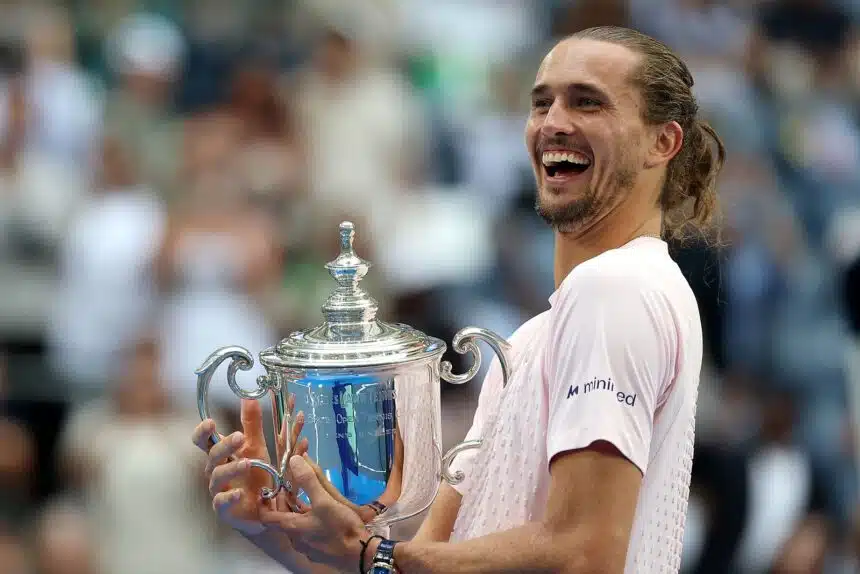
But then he broke through at last back in June. Zverev captured his first Grand Slam title at Roland Garros, and then nearly won Wimbledon before losing in a hard fought, four set final against Sinner. He arrived in New York as the top seed for the U.S. Open with high aspirations and deep resolve. In the end, despite a shaky start with back to back five set contests in the first and second rounds, Zverev was unstoppable on the hard courts. He garnered his second major title by toppling Big Ben Shelton of the United States 6-3, 7-6 (2), 5-7, 6-2.
By virtue of that impressive victory, Zverev has made a convincing case for himself as an eventual member of the International Tennis Hall of Fame. He now has two Grand Slam titles in his shining collection. Moreover, Zverev is a two-time ATP Finals champion (2018 and 2021), an Olympic gold medalist (2021), and seven times a Masters 1000 champion. That is an enviable record by any stretch of the imagination.
Zverev produced a sterling performance against Shelton in the U.S. Open final. From the moment he stepped on court for this showdown, he was composed, confident, purposeful and unswerving. At 29, he has arrived at a juncture in his career where he has unmistakably come to terms with playing under pressure. His sense of self and inner security across these last three major championships has been increasingly evident.
It was particularly apparent in his duel with Shelton that Zverev was not going to give it away. He was out there thinking only of winning, refusing to let anything get in his way, determined to control his surroundings and bring out his best tennis.
Right out of the gates, Zverev established his supremacy over the 23-year-old American left-hander. Serving at 30-40 in the opening game of the match, Shelton double faulted into the net as the German gained an immediate break. Zverev held at 15 for 2-0 and he was off and running. In the sixth game, the German trailed 0-30 but he swept four points in a row to reach 4-2 with an ace out wide. At 4-3, Zverev was down 15-30 but he collected three points in a row for the hold.
Now serving to stay in the set, Shelton stood at 30-40 when he double faulted once more into the net. Set to Zverev, 6-3.
That insurance break enabled Zverev to start serving in the second set. He had a break point for 3-1 but Shelton erased it with a service winner out wide to the backhand. Late in the set, Zverev pushed hard to get the break. Shelton was behind 15-30 at 4-5, and 0-30 at 5-6, but the American safely came out of those corners with vigor and elevated aggression to reach the tie-break, which proved to be the defining moment of the match.
Zverev was magnificent in establishing a 5-0 lead. He opened with a scorching service winner down the T. Then he passed Shelton cleanly with a forehand down the line. On the following point he took control with a penetrating forehand down the line that set up a backhand down the line winner. Two tremendous service winners took Zverev to 5-0. He soon closed it out 7-2 without losing a point on serve.
Shelton, however, was not unduly dismayed. He upped his level of aggression in the third set, as well as his level of energy. In the sixth game, the No.8 seed reached break point on the Zverev serve for the first time but the favorite poured in a 133 MPH first serve wide to the Shelton forehand that set up a backhand crosscourt winner. Consecutive service winners lifted Zverev to 3-3.
And yet, when Zverev served at 5-6 and tried to make it to another tie-break, he tightened up and Shelton was assertive. With Zverev serving at 15-40, the German bungled a routine forehand volley. Shelton had sealed the set 7-5, and the capacity audience in Ashe Stadium erupted.
But the soaring optimism of the crowd and Shelton disappeared swiftly. In the first game of the fourth set, Shelton led 30-0 but double faulted, made an overanxious forehand unforced error, and then lost the next point when Zverev laced a passing shot right at his opponent that opened up an avenue for a forehand down the line passing shot winner. Shelton gamely serve-volleyed his way out of a break point there, but Zverev quickly gave himself a second opportunity.
Once more, his forehand down the line broke open a big point. He followed with a backhand down the line chipped approach and Shelton had no play on the passing shot. Zverev thus regained control of the match in the space of five crucial minutes by securing an immediate fourth set service break, and he never relinquished it. He won 12 of 15 service points on his way to 4-2, including a love hold in the sixth game. Then Zverev broke again for 5-2. At 15-40 in the seventh game, he chased a backhand drop shot from Shelton and made three volleys. The last lunging one coaxed a lob long from Shelton. Zverev held at 15 to conclude the account, releasing a 137 MPH service winner down the T. Initially, he had no idea that the match was over but then he broke into a wide grin in recognition of what he had just done. He had had thought the score of the set was 5-1 rather than being over at 6-2.
It had been a strange fortnight for the top seed. In his first round match against the Italian Lorenzo Sonego, Zverev trailed two sets to one and served at 4-5, 30-30 in the fourth. He was two points from defeat but he made a leaping high backhand volley crosscourt that set up an open court forehand volley winner, and went on to win 6-4, 3-6, 6-7 (7), 7-5, 6-4. He was extended again in the second round in another five setter before he accounted for the Frenchman Quentin Halys 6-4 4-6, 7-6 (3), 6-7 (3), 6-3.
Thereafter Zverev settled into a comfortable groove. He knocked out No. 25 seed Alejandro Tabilo 6-2, 7-6 (2), 6-2 and handled No. 21 seed Luciano Darderi 6-2, 6-2, 7-6 (3). Now in the quarters, he defeated Botic van de Zandschulp 6-2, 7-5, 6-1, saving a set point in the second set. In the penultimate round, Zverev stopped Karen Khachanov 6-3, 7-6 (7), 7-6 (6), finishing off the second set tie-break by prevailing in a 34 stroke exchange, rallying in the third set tie-break from 4-6, double set point down to win four points in a row to complete the victory and conserve energy for the final.
Shelton’s path to the final was difficult. Facing the dangerous world No. 56 Tallon Griekspoor in the first round, he overcame an inauspicious start to win 1-6 6-1, 7-6 (3), 6-2. He ousted Poland’s big serving Hubert Hurkacz 6-2, 5-7, 7-6 (3) 7-5 in a high quality second round appointment and then made hard work of his third round meeting with the left-handed Canadian Denis Shapovalov, winning that one 7-6 (3), 6-7 (5), 6-3, 6-4. In the round of 16, Shelton easily dismissed a resurgent Stefanos Tsitsipas. The Greek stylist had upset No. 9 seed Arthur Fils in the first round and No. 18 Jiri Lehecka in the third round. He entered the Open at No. 53 in the world but now is up to No. 44, but he was no match for Shelton. The American prevailed 6-2, 6-3, 6-4.
And so the stage was set for an eagerly anticipated quarterfinal confrontation between Shelton and No.2 seed Carlos Alcaraz. The Spaniard had returned to competition after four-and-a-half months away with a wrist injury, and the defending champion had dropped only one set in four matches on his way to his meeting with Shelton. Alcaraz had looked tremendous in dissecting No. 20 seed Tommy Paul 6-4, 6-3, 6-4 in the round of 16, leading many learned observers to believe he could pull off a highly improbable run to a third U.S. Open title despite being away from the sport for so long.
Alcaraz had won all three of his career skirmishes with Shelton. The cognoscenti believed he would put on another stellar display and hand Shelton another defeat. But they had it wrong. Fundamentally wrong. In the match of the tournament and, in my view, the second best men’s match of the 2026 season behind Novak Djokovic’s five set semifinal victory over Jannik Sinner at the Australian Open, Shelton overcame Alcaraz in a five set humdinger. The Spaniard had won twelve consecutive five set encounters. Only once in sixteen career five-setters had Alcaraz come out on the losing end.
What gave this match added luster was the fact that the finest tennis was played in the first and fifth sets. It commenced on a high note and ended with greater gusto. In between the level of play on both sides of the net fluctuated, but the fact remains that the combined heroics of these two warriors was breathtaking.
At 5-5 in the first set, Shelton was broken at love but Alcaraz lost his serve in the following game at 15 with a pair of wild forehand mistakes. In the ensuing tie-break, Shelton was two points away from a one set lead at 5-3 but Alcaraz took four consecutive points to move out in front as he rediscovered his range off the forehand. After Alcaraz held in a long game for 1-0 in the second set, Shelton swept no fewer than nine straight games to take the second set and build a 3-0 lead in the third.
Irrefutably, Alcaraz played poorly during this stretch of the match as Shelton maintained his high standards. Most strikingly, he was holding his own and even surpassing Alcaraz at times from the backcourt. Meanwhile, the southpaw’s serve was giving the Spaniard fits. But Alcaraz— who had looked exhausted after long points and uncertain with his shot selection— recovered his competitive equilibrium and made a considerable push at the end of that third set.
After holding three straight times, he made Shelton work hard to hold when the American served for a two sets to one lead. Alcaraz had a break point in the ninth game but Shelton sedulously stood his ground. Alcaraz managed to return a 148 MPH first serve and then fought fiercely in a 19 stroke rally before netting a forehand down the line. Shelton held on from there to close out the third set.
But the way he had played at the end of the third set carried Alcaraz through the fourth commandingly at the cost of only one game. On they went to a stirring fifth set. At 2-2, Shelton was break point down when he served-and-volleyed. The first volley was arduous but he punched it deep. Alcaraz tossed up a lob and Shelton managed to send his smash almost right at the Spaniard, who was trapped. Shelton held on gamely. When Shelton led 4-3, he had three break points which would have allowed him to serve for the match. But he chipped a backhand approach long on the first, left his drop volley sitting up on the second to enable Alcaraz to nail a passing shot, and missed a routine backhand crosscourt on the third. Alcaraz somehow held on for 4-4.
And yet, Shelton did not dwell on that disappointment. He lost only one point in his next two service games on his way to the tie-break, and Alcaraz was equally steadfast when he served to stay in the match at 4-5 and 5-6. He dropped only two points in his pair of service games. They proceeded to a memorable match tie-break, and Alcaraz recovered from 1-3 down to lead 5-3.
Shelton was unfazed by his predicament. He produced an excellent body serve that stifled Alcaraz to make it 5-4 and then Alcaraz sprayed a forehand well out of court. But then the Spaniard released a body serve Shelton could not handle. It was 6-5 for Alcaraz. Alcaraz had an opening for a backhand down the line winner on the next point but sent it long for 6-6. Buoyed by that pendulum swinging point, Shelton unleashed a 146 MPH service winner into Alcaraz’s body to take a 7-6 lead and then advanced to 8-6 on another forehand driven long by the Spaniard. Alcaraz won the next point with a forehand volley winner but now Shelton served the next two points with victory in sight. He did not falter, stifling Alcaraz with a heavy second serve that drew an errant backhand return, and then ending it all emphatically with a 146 MPH ace out wide in the deuce court.
In four hours and 28 minutes, Shelton stunned Alcaraz 6-7 (5), 6-1, 6-3, 1-6, 7-6 (10-7) for the biggest win of his career. It was 3:33 A.M. when Shelton wrapped that triumph. He then backed up that extraordinary win by coming from behind to defeat countryman Frances Tiafoe 4-6, 6-3, 6-3, 7-5. Tiafoe was appearing in his third U.S. Open semifinal in a five year span and he played a first rate match. But after Shelton double faulted on break point at 4-4 in the first set in a costly moment, he dominated the last three sets, losing his serve only one more time, outhitting Tiafoe from the baseline and attacking at all the right moments. Tiafoe had made a spectacular comeback against countryman Alex Michelson in the quarterfinals. Michelson had not lost a set in the tournament up until he served for the match at 5-4 in the third set, but he met that moment trepidatiously, commencing that game with a pair of double faults. Tiafoe broke him there, won that set as well as the fourth, but fell behind 0-3 in the fifth set.
Once more, Tiafoe struck back boldly and got back on serve. And yet, at 4-5 in that fifth set he was twice two points from defeat before serving aces on both critical points. The 28-year-old was too good in the match tie-break, prevailing 10-6, winning this gripping contest 5-7,3-6, 7-5, 6-3, 7-6 in four hours and 39 minutes.
And what about Djokovic? Hoping to find some of his old magic at the majors, the 24 time Grand Slam tournament victor seemed ready to close out his first round match against world No. 49 Mariano Navone when he led two sets to one and moved ahead 2-1 in the fourth with a break. From that juncture, Djokovic lost eleven of the last twelve games and bowed out 7-6 (5), 5-7, 4-6, 6-2, 6-1.
The 39-year-old Serbian had been victorious in 77 consecutive first round matches at the Grand Slam events. He was clearly impaired that evening by an ailing back and shoulder plus an ongoing stomach issue that caused him to throw up on the court. The feeling grows that he won’t tolerate many more losses like this one as his body and his health so frequently betray him.
But, in the end, this tournament was about the winning campaign of Sascha Zverev. At 29, he is celebrating a banner year. The German has not won any titles outside the two majors he has garnered, but the fact remains he is leading in the race to Turin and he might well finish the year ahead of Sinner in the top spot. Zverev must be commended for his enduring commitment and his perspicacity. From here on in, for however long he plays, no matter what the circumstances, Zverev should swing freely, play enjoyably and realize anything he achieves is simply icing on the cake.